ChatGPT Ads for Small Businesses: How They Work and Whether to Test Them
OpenAI's ChatGPT ads are open to US advertisers. Here is how they work, who sees them, and a sensible way for small businesses to test them.
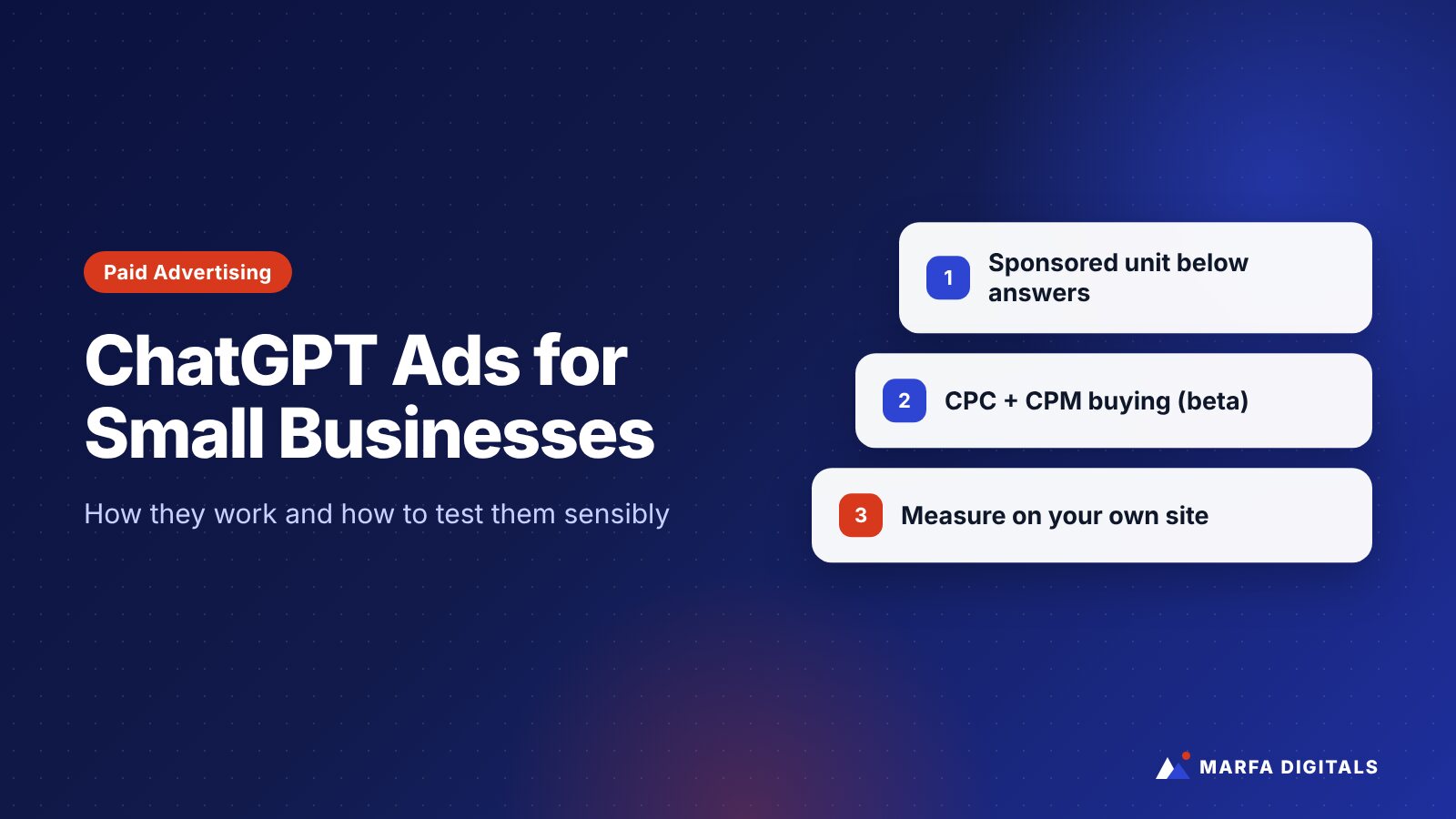
ChatGPT ads are sponsored listings that appear below ChatGPT’s answers when an advertiser’s product or service matches the conversation. OpenAI began testing them in the US on February 9, 2026, and opened a self-serve Ads Manager beta to US advertisers in May 2026 with cost-per-click buying. For most small businesses, the right move today is a small, tightly measured test, but only after your Google Search, website, and conversion tracking are already working.
Every new ad channel brings the same pressure: get in early or fall behind. ChatGPT is different from most new channels because people use it while they are actively researching, comparing, and asking for recommendations. That makes it interesting for US businesses. It also makes it easy to spend money before you understand what you are buying.
This guide separates what OpenAI has actually confirmed from what is still unknown, explains how the ads work, and gives you a practical way to decide whether your business should test them.
What Are ChatGPT Ads?
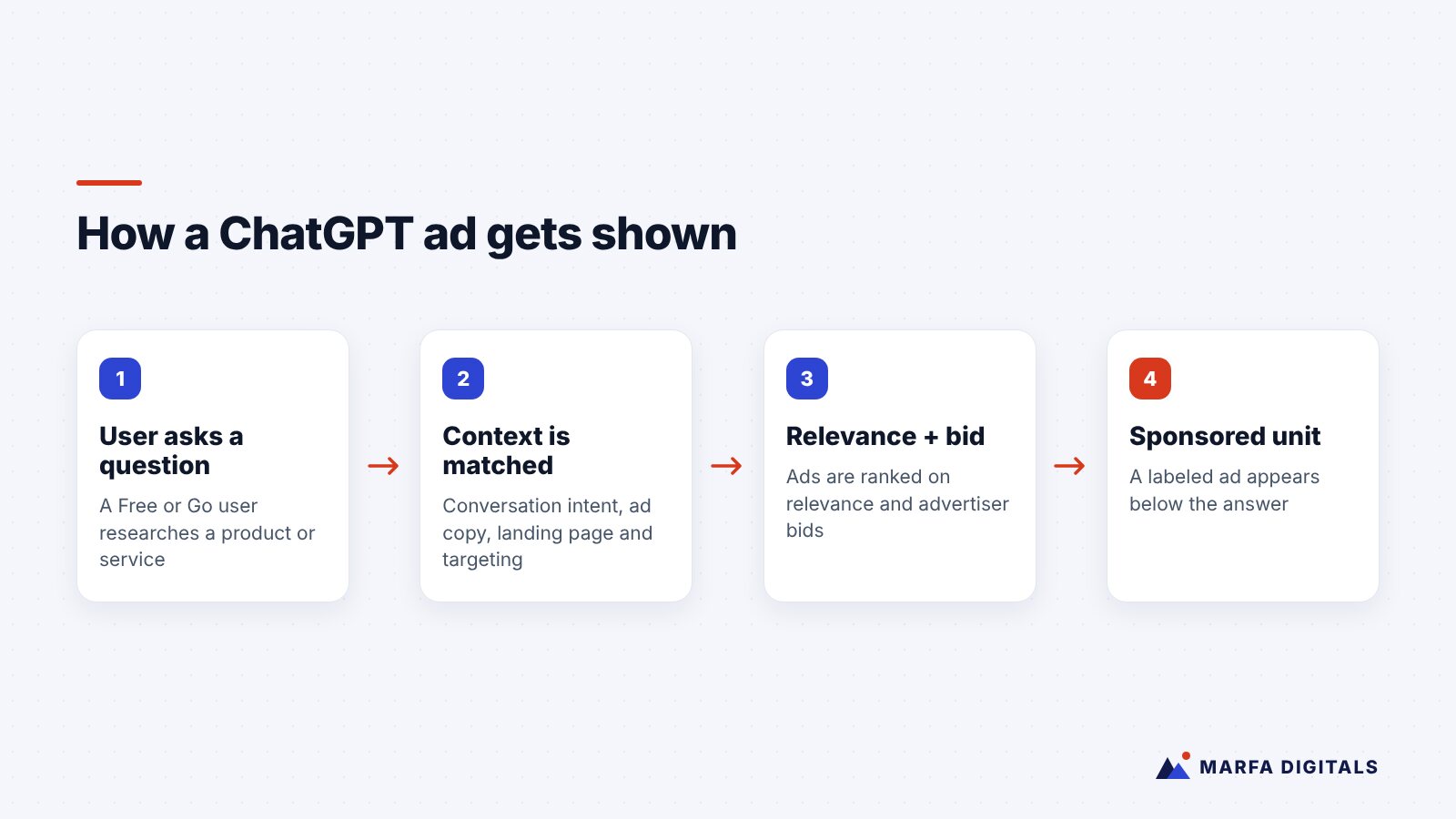
ChatGPT ads are paid placements that show up underneath a ChatGPT response. According to OpenAI’s Help Center, they are labeled as sponsored, visually separated from the answer, and may include one or more ad units when there is a relevant match.
The key point for advertisers is that the ad sits next to the answer. It does not change the answer. OpenAI states that ads run on systems separate from the chat model and that advertisers cannot shape, rank, or alter ChatGPT’s responses.
The verified timeline so far
| Date | What happened | Source |
|---|---|---|
| January 16, 2026 | OpenAI published its advertising principles and announced plans to test ads in the US for Free and Go users. | OpenAI |
| February 9, 2026 | Ad testing began in the United States. | OpenAI Help Center |
| May 5, 2026 | A self-serve Ads Manager beta began rolling out to US advertisers. Cost-per-click buying was added alongside cost-per-impression, and the previous high minimum for test campaigns was removed. | Axios |
Because the product is new and still changing, check OpenAI’s current documentation before you launch. Details such as country availability, ad formats, and reporting can change quickly.
Who Sees ChatGPT Ads?
Based on OpenAI’s published help documentation:
- Free and Go users may see ads.
- Plus, Pro, Business, Enterprise, and Edu accounts do not see ads.
- Accounts identified or predicted as belonging to people under 18 do not see ads.
- Temporary Chats do not show ads.
- Ads are not placed near conversations about personal health, mental health, or politics, and political advertising is not currently allowed.
That last group matters for some industries. Healthcare, financial services, and other regulated advertisers may face extra eligibility criteria, so they should review OpenAI’s policies before planning a campaign.
There is also a planning implication. Many business decision-makers use paid ChatGPT plans at work, and those plans do not show ads. A B2B company targeting executives may reach a smaller share of its audience in ChatGPT than a consumer brand would. That does not rule ChatGPT out, but it should temper expectations.
How Are Ads Chosen and Ranked?
OpenAI says ad selection considers:
- The context and intent of the current conversation
- The ad’s landing page, title, and copy
- Context hints and targeting the advertiser provides
- For users with personalization turned on, select signals from their wider ChatGPT use
Ranking weighs relevance and the advertiser’s bid. In plain terms, money alone does not guarantee placement. A clear ad that matches what someone is asking about, backed by a landing page that actually answers that need, should have an advantage. This is similar to how quality and relevance affect Google Ads, although OpenAI has not published a formula.
What advertisers can and cannot see
Privacy is one of the biggest differences from social ad platforms. OpenAI states that advertisers receive aggregated, non-identifying performance data such as views and clicks. Advertisers do not receive users’ chats, chat history, memories, names, email addresses, precise location, or IP addresses.
For you, this means most of your measurement has to happen on your own website. If your analytics, conversion tracking, and CRM are not set up properly, you will see clicks but have little idea whether those clicks became customers.
ChatGPT Ads vs Google Ads: What’s Different?
| Google Search Ads | ChatGPT Ads | |
|---|---|---|
| Where the ad appears | Search results, Maps, and Google’s network | Below a ChatGPT answer |
| What triggers it | Keywords and Google’s matching systems | Conversation context and intent, plus advertiser inputs |
| Maturity | Mature, with detailed controls and reporting | New, with a beta Ads Manager |
| User mindset | Often ready to call or buy now | Often researching, comparing, or planning |
| Data available to advertisers | Search terms, conversions, audiences | Aggregated views and clicks; conversion data comes from your own tracking |
For a plumber, a dentist, or a law firm that depends on people who need help today, Google Search usually remains the core channel. ChatGPT may be more useful earlier in the decision, when someone is asking, “What should I look for in a commercial HVAC contractor?” or “Which CRM is best for a 20-person sales team?”
Should Your Business Test ChatGPT Ads?
Here is the honest answer: it depends less on ChatGPT and more on the state of your existing marketing. A new channel tends to amplify what is already there. If your website converts poorly, ChatGPT traffic will convert poorly too.
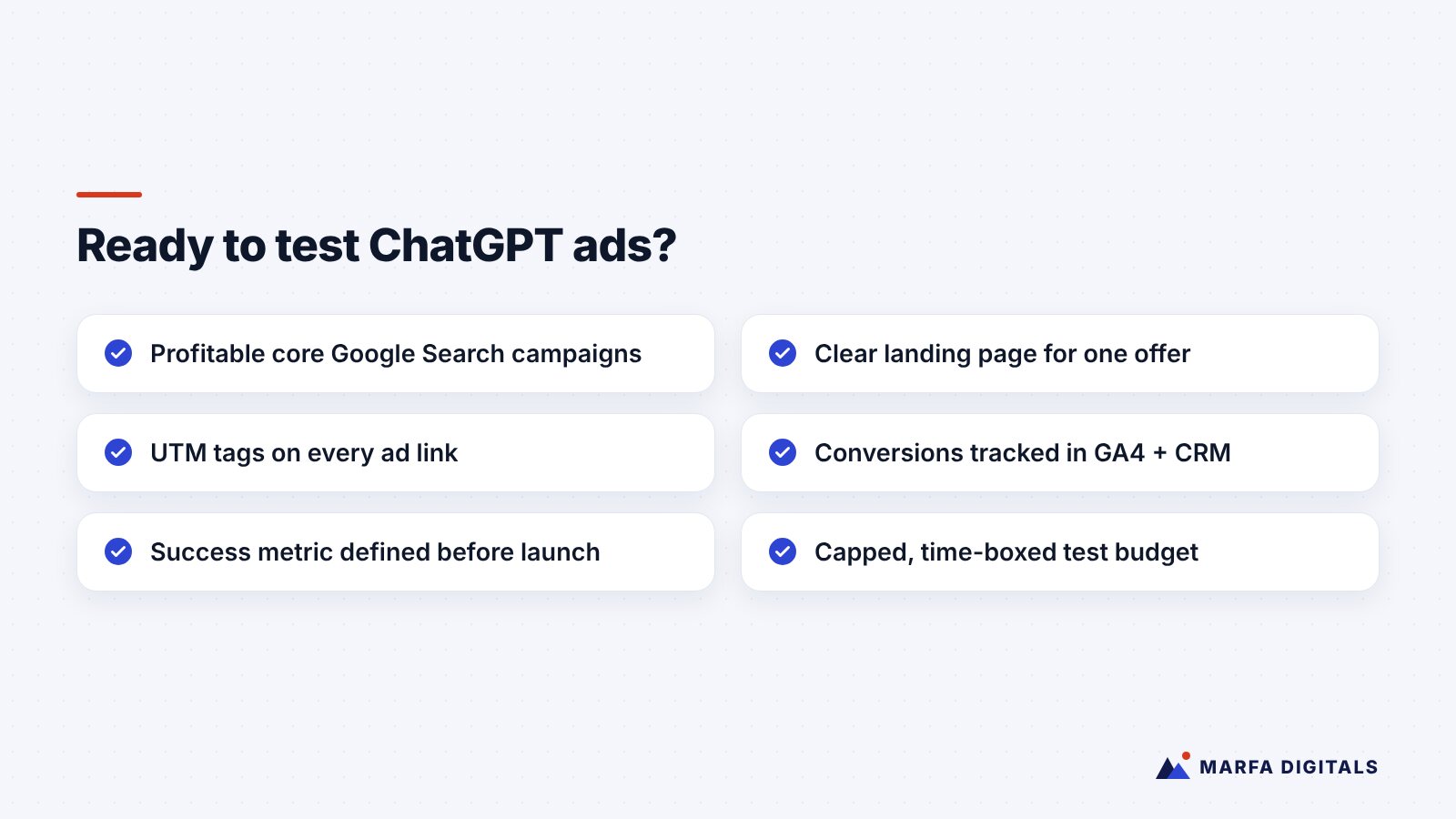
You are a good candidate if:
- Your Google Search campaigns are profitable and you are looking for incremental reach.
- Your customers research before they buy, such as B2B services, SaaS, home renovation, or considered e-commerce purchases.
- You have landing pages that explain your offer clearly, including pricing ranges, comparisons, or “how it works” sections.
- Conversion tracking is in place, and form fills and calls flow into a CRM.
- You can set aside a test budget that you are comfortable treating as a learning cost.
Wait if:
- You do not know your current cost per lead or cost per customer.
- Your website is slow, unclear, or hard to use on mobile.
- You are in a sensitive or regulated category and have not confirmed eligibility.
- Your core Google or Meta campaigns are still unprofitable.
How to Run a Sensible First Test
- Pick one offer. Choose a single service or product line with clear demand and good margins. Do not launch your whole catalog at once.
- Build or choose a matching landing page. The page should answer the research questions people ask in ChatGPT: who it is for, what it costs or what affects price, how it compares, and what happens next.
- Tag every link. Use UTM parameters so ChatGPT traffic is separated in Google Analytics 4 and your CRM.
- Define success before launch. Decide what counts as a win: qualified leads, booked calls, or purchases at an acceptable cost.
- Cap the budget and timebox it. Run long enough to collect meaningful data, then review. If your sales cycle is long, judge early results on lead quality, not just closed deals.
- Compare against your best channel. Look at cost per qualified lead and lead quality next to Google Search, not in isolation.
Don’t Ignore Organic Visibility in ChatGPT
Paid placements are only part of the picture. ChatGPT’s answers themselves often recommend brands, products, and service providers, and you cannot buy your way into those answers. Showing up there depends on what the web says about you: your website content, third-party reviews, directory listings, and mentions in credible publications.
If you serve a local market, our guide to getting recommended in Google’s AI Mode covers the local side of this. For broader brand visibility, a strong SEO foundation is still the starting point.
Frequently Asked Questions
How much do ChatGPT ads cost?
OpenAI has not published standard pricing. Costs are set through bidding, and the self-serve platform supports cost-per-click and cost-per-impression buying. Your actual cost will depend on competition, relevance, and your bids. Start with a small, capped test.
Can I advertise on ChatGPT if I’m a local business?
US advertisers can sign up through OpenAI’s Ads Manager at ads.openai.com. Whether local targeting is precise enough for your service area is something to verify inside the platform before you commit budget.
Do ChatGPT ads affect what ChatGPT recommends?
According to OpenAI, no. Ads are shown separately from answers, and advertisers cannot influence the response itself.
Will ChatGPT ads replace Google Ads?
There is no evidence of that today. For most businesses, Google Search still captures the highest-intent demand. ChatGPT ads are better viewed as a potential addition to a proven channel mix, not a replacement.
The Bottom Line
ChatGPT ads are worth watching and, for the right businesses, worth testing. But the businesses that will benefit most are the ones that already have clear offers, fast landing pages, and reliable tracking. Get those right first, then treat ChatGPT as a measured experiment.
If you want help deciding whether ChatGPT ads fit your channel mix, or want your current campaigns audited first, our performance marketing team can help. Request a free growth plan and we will review where your next dollar should go.
Sources
- OpenAI Help Center, Ads in ChatGPT
- OpenAI, Our approach to advertising and expanding access (January 16, 2026)
- Axios, OpenAI launches self-serve ad platform (May 5, 2026)