
Shopify Agentic Commerce: How to Get Your Store Ready for AI Shopping Agents
AI assistants can now find and buy products from Shopify stores. Here is what Shopify launched in 2026 and how to get your store ready.
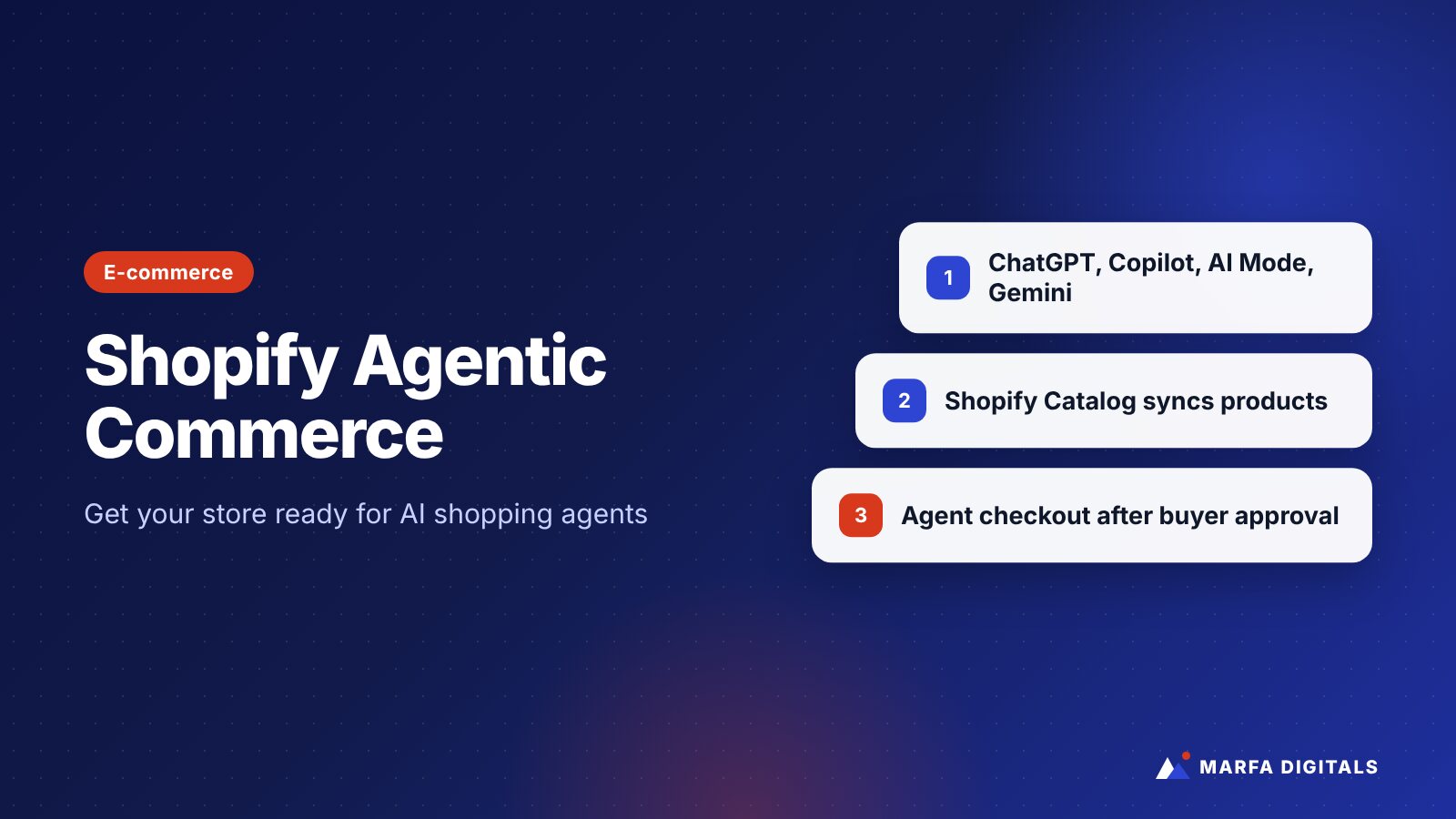
Agentic commerce means AI assistants such as ChatGPT, Microsoft Copilot, Google’s AI Mode, and the Gemini app can find products and help shoppers buy them, sometimes without the shopper ever browsing your website. Shopify now syndicates merchants’ products to these AI channels through Shopify Catalog and Agentic Storefronts, and in September 2026 it began letting browser-based AI agents complete checkout on Shopify stores after the buyer authorizes the purchase. To get ready, Shopify merchants should focus on complete product data, clear policies, accurate inventory, and attribution tracking.
For years, e-commerce growth followed a familiar path: a shopper searches, clicks an ad or a product listing, browses your store, and checks out. That path is not disappearing, but a new one is opening beside it. More shoppers are asking AI assistants to compare products, recommend options, and in some cases, complete the purchase for them.
If you sell on Shopify, this shift is happening inside the platform you already use. Here is what has changed, what it means for US e-commerce brands, and what to fix before the holiday season.
What Is Agentic Commerce?
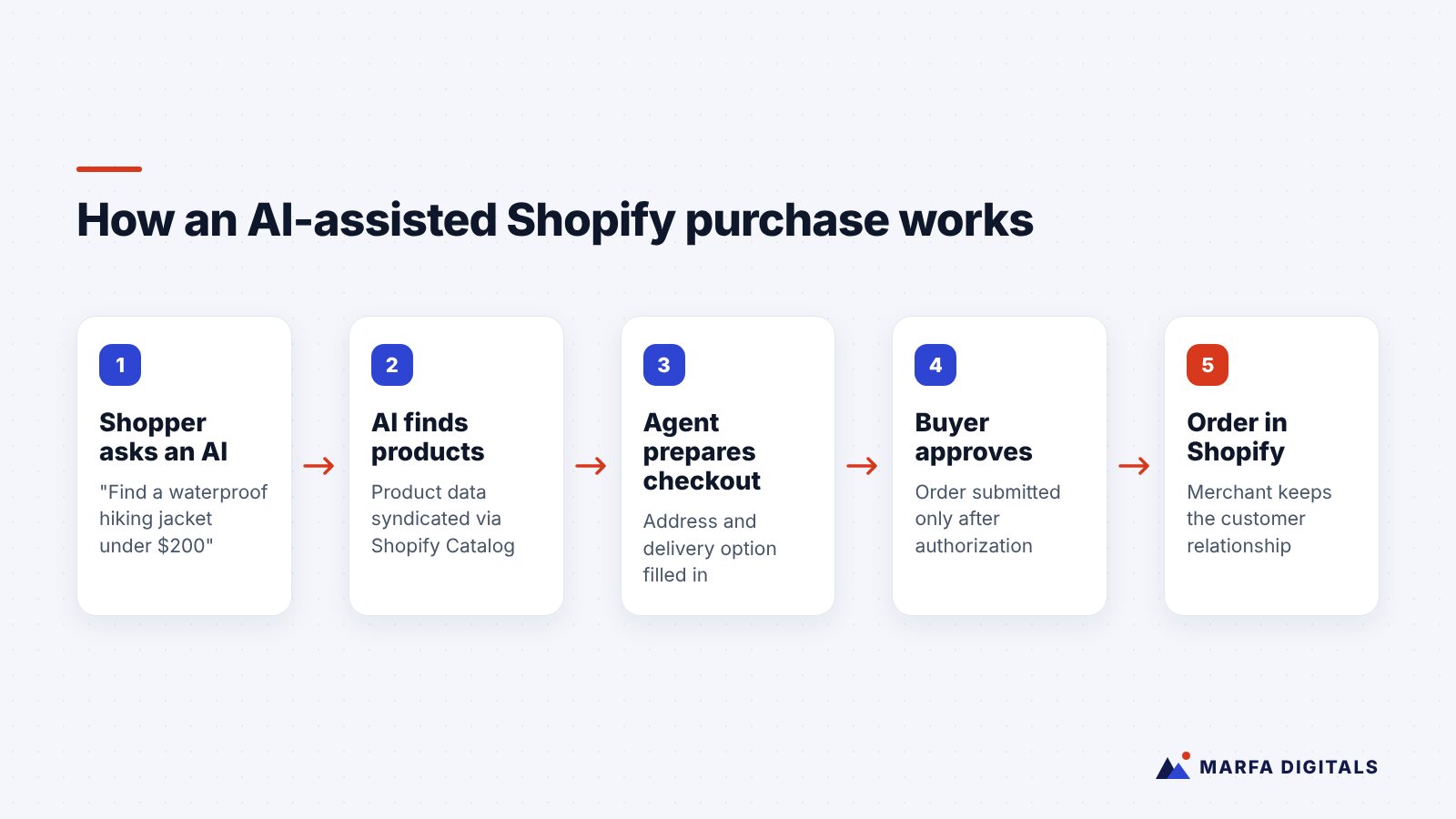
Agentic commerce is shopping where an AI agent acts on the shopper’s behalf. Instead of returning a list of links, the agent can search across stores, compare products against the shopper’s requirements, fill in checkout details, and submit an order once the shopper approves.
The important difference from traditional search is that the AI decides which products to present. Your product data, policies, and reputation become the inputs it uses to make that choice.
What Shopify Has Launched in 2026
Agentic Storefronts and Shopify Catalog (March 2026)
In a March 24, 2026 announcement, Shopify said merchants can sell across ChatGPT, Microsoft Copilot, AI Mode in Google Search, and the Gemini app, managed from the Shopify Admin through Agentic Storefronts. Key points from Shopify’s announcement:
- Products are syndicated to AI channels through Shopify Catalog, with inventory and pricing kept in sync.
- In ChatGPT, products are discoverable by default, and orders show ChatGPT referral attribution in the Shopify Admin.
- Merchants remain the merchant of record and keep the customer relationship and data.
- Google’s AI Mode and Gemini integrations run on the Universal Commerce Protocol (UCP), which Shopify co-developed with Google.
- Brands that do not use Shopify for e-commerce can add products to Shopify Catalog through an Agentic plan.
Checkout for browser-based AI agents (September 2026)
On September 28, 2026, TechCrunch reported that Shopify added WebMCP support for checkout, including Shop Pay. Previously, browser-based agents could search products and add items to carts. Now they can read and update checkout details, such as the shipping address or delivery option, and submit the order after the buyer authorizes it. Shopify said this is rolling out to eligible merchants.
Not every retailer is embracing this. The same report noted that some large retailers block AI agents from purchasing on their sites. Shopify is taking the opposite approach and opening its merchants to agent-driven sales.
Why This Matters for Shopify Merchants
- Your product page may not be the first thing a shopper sees. An AI assistant may summarize your product before the shopper ever visits your store. If your titles and descriptions are vague, the summary will be vague too.
- Data quality becomes a competitive advantage. When an agent compares two similar products, the one with complete specifications, sizing, materials, and clear policies is easier to recommend.
- Attribution gets more complicated. Some sales will originate in AI conversations. If you only look at last-click reports in your ad platforms, you may misjudge what is driving revenue.
- Brand trust still decides close calls. Reviews, return policies, and consistent information across the web help an AI system, and the human approving the purchase, feel confident choosing you.
How to Prepare Your Shopify Store for AI Shopping Agents
1. Rewrite product titles for clarity, not cleverness
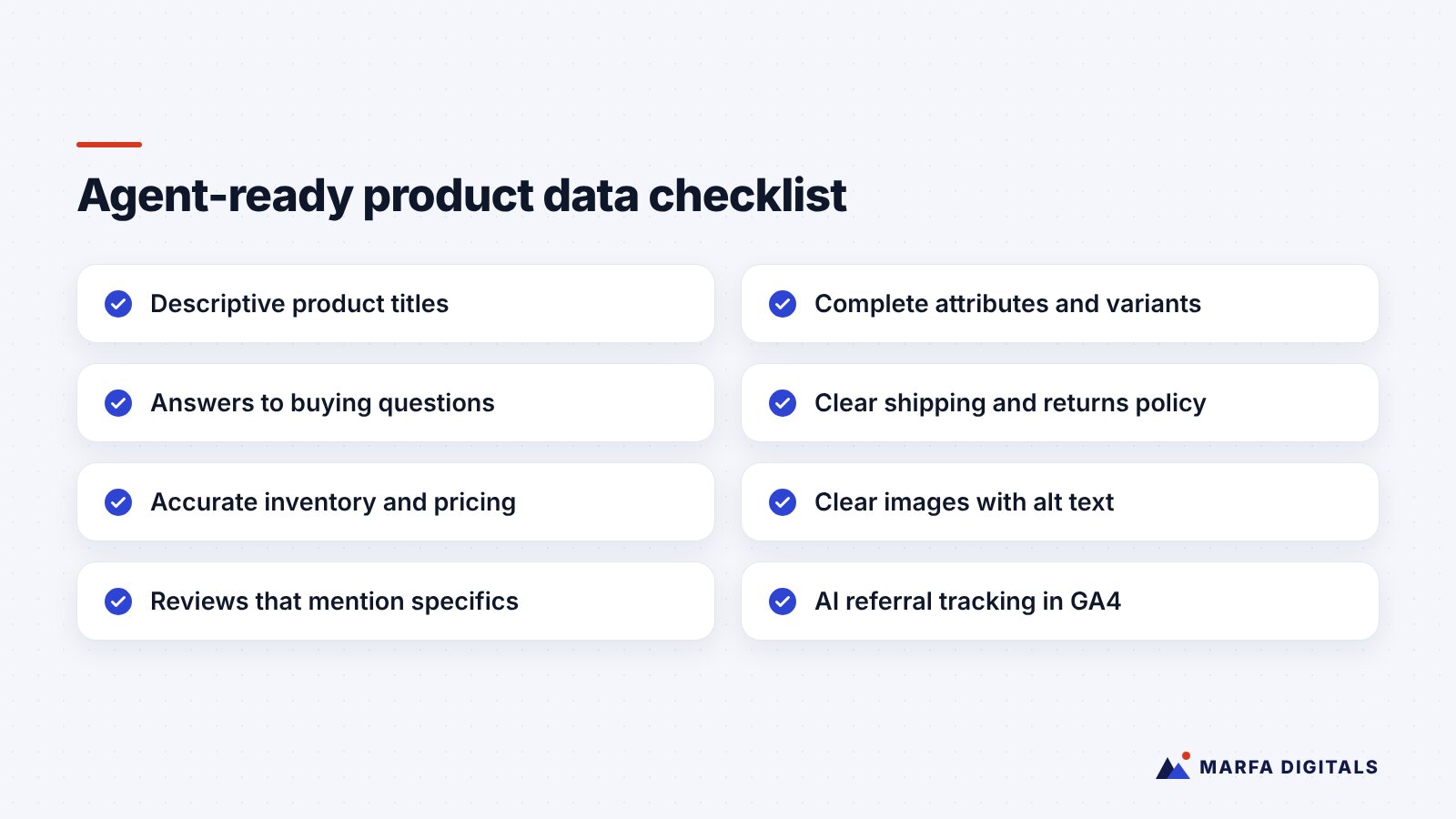
A title like “The Weekender” tells an AI agent almost nothing. “The Weekender Waxed Canvas Duffel Bag, 45L, Leather Handles” tells it what the product is, its size, and its key materials. Keep your brand voice in the description, but make titles descriptive.
2. Fill in every product attribute you can
Use Shopify’s product fields, variants, and metafields to record size, color, material, dimensions, compatibility, care instructions, and anything else a shopper would use to compare. If a shopper asks for a “machine-washable rug under 8 feet,” the agent needs that data to include your product.
3. Answer real buying questions in your descriptions
Think about the questions your customer service team hears every week: Does it run small? Will it fit this model? How long does shipping take? Answer them in plain language on the product page or in a short FAQ section.
4. Make shipping, returns, and warranty policies easy to find
Agents and shoppers both need to know delivery times and return terms before purchasing. Keep policies specific, current, and consistent between your store, Google Merchant Center, and marketplaces.
5. Keep inventory and pricing accurate
Shopify Catalog syncs inventory and pricing, but only if your store data is right. Overselling or showing outdated prices to AI channels creates cancellations and erodes trust.
6. Use high-quality images that show the product clearly
Include clean product shots, scale references, and lifestyle images. Use descriptive alt text so the images are also understandable as text.
7. Build reviews that mention specifics
Ask customers to describe how they used the product, not just whether they liked it. Reviews that mention fit, durability, or use cases give AI systems useful detail. Never buy or fabricate reviews; the FTC’s rule banning fake reviews allows civil penalties.
8. Review your Agentic Storefronts settings
Check the Agentic Storefronts area of your Shopify Admin to see which AI channels are active for your store and how products are being shared. Confirm Shop Pay is set up if you want the smoothest checkout experience.
9. Track AI-referred orders separately
Watch for ChatGPT and other AI referral attribution in your Shopify order data, and set up a segment in Google Analytics 4 for AI assistant referral sources. Review these orders monthly to see which products AI channels favor.
What Not to Do
- Do not rebuild your whole store at once. Start with your top-selling products and the categories with the most competition.
- Do not stuff keywords into titles. Write for clarity. A title packed with keywords is harder for both people and AI systems to interpret.
- Do not neglect your own site. Many shoppers will still visit your store before buying. A fast, trustworthy, mobile-friendly store remains essential.
What About Ads?
AI channels do not replace paid acquisition. Meta, Google Shopping, and Performance Max remain the main drivers of new customer volume for most Shopify brands. What changes is how those channels work together. Better product data improves your Google Shopping feed and your AI visibility at the same time.
In one Shopify engagement featured in our case studies, the combination of a creative testing system, Shopify conversion fixes, and automated email flows reached a 4.2× return on ad spend. The lesson applies here too: channel performance depends on what happens on your store and after the click, not just on the ads.
Frequently Asked Questions
Do I need a separate app to sell in ChatGPT?
According to Shopify, products are discoverable in ChatGPT by default through Agentic Storefronts, without separate integrations or apps. Check your Shopify Admin for the current settings that apply to your store.
Will AI agents replace my online store?
No. AI agents add a new path to purchase. Your store, brand, and customer relationships remain central, and Shopify says merchants stay the merchant of record.
Is agentic commerce only for large brands?
No. Because Shopify handles the syndication, small and mid-sized merchants can participate. Their advantage comes from better product information and stronger customer reviews, not ad budget.
Get Your Store Ready Before the Holidays
With Black Friday on November 27, 2026, now is the time to clean up product data, tighten policies, and make sure tracking captures every channel. If you want help auditing your Shopify store or building a holiday growth plan, our web development and performance marketing teams work together on exactly this. Contact Marfa Digitals to start the conversation.
Sources
- Shopify, Agentic commerce momentum (March 24, 2026)
- TechCrunch, Shopify opens checkout to browser-based AI agents (September 28, 2026)
- Federal Trade Commission, Final rule banning fake reviews and testimonials (August 2024)
Related articles
 E-commerce Texas Sales Tax on Shopify: Setup Guide for Dallas Store Owners (2026)
Read article
 E-commerce Shopify Store Development in Dallas: Cost, Timeline and What You Should Get
Read article
 Google Ads Google Ads for Roofers: How Roofing Companies Get More Inspections and Signed Jobs
Read article