
AI Automation for Texas Small Businesses: Chatbots, Lead Follow-Up and CRM by City
A practical guide to AI chatbots, lead follow-up automation, CRM and workflow automation for Texas small businesses — what to automate first, costs and city guides.
AI automation helps Texas small businesses answer leads faster, book more appointments and cut admin work. The four highest-return automations are: an AI chatbot that answers questions and books 24/7, lead follow-up automation that texts and emails every new lead within a minute, CRM automation that keeps every lead in one pipeline with reminders, and workflow automation for reviews, invoices and reports. Start with lead follow-up — it usually pays back fastest.
AI has moved from experiment to everyday tool for small businesses. The U.S. Chamber of Commerce’s 2025 Empowering Small Business report found that 58% of small businesses now use generative AI, up from 40% the year before. In Texas — home to about 3.5 million small businesses, according to the SBA Office of Advocacy — that shift is happening fast, from Houston law firms to Lubbock roofers.
This guide is the hub of our Texas AI automation series. It explains what to automate first, what it costs, and links to city-specific guides.
Why Speed Matters More Than Ever
A widely cited Harvard Business Review study, “The Short Life of Online Sales Leads”, found that companies contacting leads within an hour were nearly seven times as likely to qualify them as those that waited longer. Today customers expect even faster replies — often within minutes. Most small business owners can’t answer every call and form while on a job site, in a patient room or with a customer. Automation fills that gap.
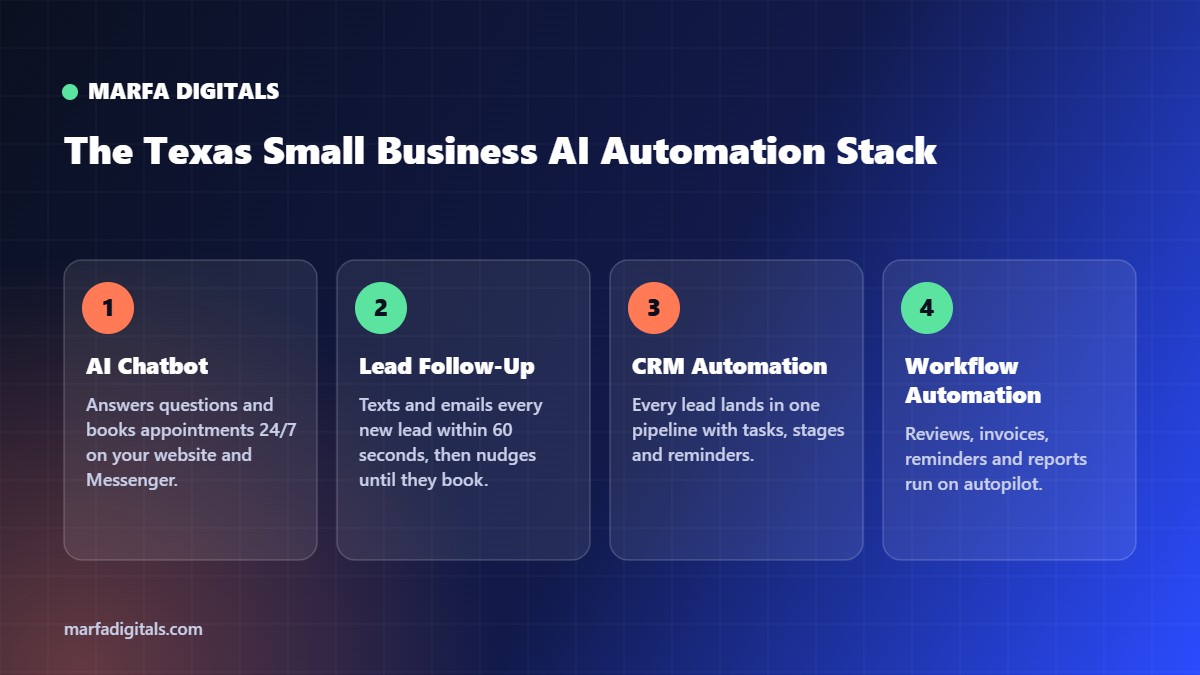
The 4 AI Automations That Pay Off First
1. AI chatbots
A modern AI chatbot is trained on your services, prices, service areas and policies. It answers questions on your website, Facebook Messenger, Instagram or SMS, qualifies the lead and books an appointment — including at 10pm on a Sunday. Learn more about our AI chatbot development or read whether an AI chatbot for your small business website is worth it.
2. Lead follow-up automation
Every new lead from Google Ads, Facebook, your website or a missed call gets a personal text and email within 60 seconds, followed by gentle reminders until they book or reply. This is usually the fastest win. See our lead follow-up automation service and the guide to missed call text back.
3. CRM automation
Your CRM becomes the single home for every lead, with pipeline stages, assigned tasks and automatic reminders. No more leads living in a notebook or someone’s inbox. Explore CRM automation.
4. Workflow automation
Review requests after every job, estimate follow-ups, appointment reminders, invoice nudges and weekly reports — all running automatically. See our workflow automation service and 7 marketing automation workflows for small businesses.
What Does AI Automation Cost?
- Software: many CRMs and automation tools cost roughly $50–$500 per month for a small team, plus SMS and AI usage fees.
- Setup: a one-time project to connect your website, ads, phone and calendar and build the workflows.
- Ongoing: optional monthly optimization — reviewing chatbot answers, adjusting sequences and reporting.
The right question isn’t “what does it cost?” but “how many leads am I losing now?” If your team misses even a few calls or forms a week, automation usually pays for itself quickly. An AI receptionist is another option for phone-heavy businesses.
AI Automation Across Texas: What Changes by City
The automations above work everywhere, but the setup changes with the local market: the language your customers use, the industries that dominate, the time zone and how fast competitors respond. Here is what we adjust in the Texas cities we work with most.
Dallas: Lead Follow-Up Automation
In a market as competitive as Dallas, the business that responds first usually wins the job. Instant text replies, missed-call text-back and automatic reminders matter most here. See our full guide to lead follow-up automation in Dallas.
Fort Worth: Workflow Automation for Trades
Fort Worth has a large base of contractors and industrial service companies. The biggest wins are usually in the back office: turning a booked job into a work order, sending crew schedules, collecting photos and sending invoices without manual re-entry.
Arlington: Chatbots for Home Services
Arlington sits between Dallas and Fort Worth, so home service companies there often cover the whole Mid-Cities area. A website chatbot that asks for ZIP code, service type and preferred time can qualify leads and book estimates after hours, when many homeowners do their research.
Plano: CRM Integration
Plano is home to many corporate headquarters and B2B service firms. These businesses usually already have tools (accounting, scheduling, email) that do not talk to each other. Connecting forms, ad leads and phone calls into one CRM gives a clear view of every lead and where it came from.
Houston: AI Chatbots at Scale
Houston is a huge, spread-out and multilingual market. Chatbots that answer in English and Spanish, route leads to the right location or service area, and hand off to a person for complex questions help businesses handle high volume without adding staff.
The Woodlands: Chatbots for Medical and Dental Practices
The Woodlands, north of Houston, has many medical, dental and specialty practices. Chatbots can answer common questions about services, insurance and hours, and help patients request appointments. They should not collect detailed health information unless the chatbot platform and setup meet HIPAA requirements, and practices should review any patient-facing automation with their compliance advisor.
Austin: Chatbots for Tech-Savvy Customers
Austin customers expect fast, digital service. Chatbots that give real answers (pricing ranges, availability, next steps) instead of only collecting contact details tend to convert better. Integrations with online booking and payment are often worth the extra setup.
San Antonio: CRM Automation
San Antonio businesses often depend on repeat customers and referrals. CRM automation for review requests, service reminders and re-engagement messages for past customers can produce more revenue than chasing new leads alone. Bilingual message templates are often a must.
Corpus Christi: Workflow Automation for Contractors
Demand for roofing, HVAC and restoration work in Corpus Christi can spike around storms. Automation that captures every inquiry, sends status updates and keeps jobs moving from estimate to invoice helps contractors handle those surges without losing leads.
El Paso: Bilingual Lead Follow-Up
El Paso is the only major Texas city in the Mountain Time zone, and it is a bilingual, cross-border market. Follow-up sequences should send in the customer’s preferred language and respect local hours, so messages scheduled on Central Time do not arrive an hour early.
Choosing a CRM first? Compare options in our best CRM for Texas small businesses guide. Running ads too? Automation makes every ad dollar work harder. See our Texas small business marketing guide.
Where to Start This Week
- Count how many calls and forms went unanswered for more than an hour last month.
- Write down your 20 most common customer questions — this becomes your chatbot’s knowledge.
- Choose one CRM and send every lead source into it.
- Turn on an instant text reply for new leads and missed calls.
- Add an automatic review request after every completed job.
Ready to stop losing leads to slow replies?
We build AI chatbots, lead follow-up, CRM and workflow automation for Texas small businesses. Explore our AI automation services.
Get a Free Automation Plan →Frequently Asked Questions
What is AI automation for small businesses?
It is using AI tools and connected software to handle repetitive work automatically, such as answering customer questions, replying to new leads, updating your CRM, sending reminders and requesting reviews.
What should a small business automate first?
Lead follow-up. An instant text and email to every new lead and missed call usually brings the fastest return, followed by a CRM pipeline and an AI chatbot.
How much does AI automation cost for a Texas small business?
Software often runs about $50–$500 per month for a small team plus usage fees, with a one-time setup project. Most businesses recover the cost by booking leads they used to miss.
Will an AI chatbot replace my staff?
No. A good chatbot handles common questions and after-hours inquiries, then hands complex or urgent conversations to your team, so staff spend time on higher-value work.
Related articles
 Marketing Automation & AI AI Chatbots for Small Business Websites: What They Can Do and How to Set One Up
Read article
 Marketing Automation & AI Marketing Automation for Small Business: 7 Workflows to Set Up First
Read article
 Marketing Automation & AI AI Receptionists for Small Businesses: Are They Worth It for Service Companies?
Read article