
Small Business Marketing in Texas: Google Ads, Meta Ads & Local SEO City Guide (2026)
A practical, city-by-city guide to Google Ads, Facebook/Instagram ads and local SEO for Texas small business owners — what to start with, what it costs and how to get more booked jobs.
Most Texas small businesses get the fastest, most reliable leads by combining three channels: local SEO (a strong Google Business Profile and reviews so you show in the map pack), Google Ads (to capture people searching for your service right now) and Meta Ads on Facebook and Instagram (to reach nearby customers before they search). Start with your Google Business Profile, add a tightly targeted Google Ads campaign, then layer Meta Ads once calls are being tracked.
Texas is one of the best places in the country to run a small business — and one of the most competitive places to win customers online. According to the SBA Office of Advocacy 2025 Texas profile, the state has about 3.5 million small businesses, making up 99.8% of all Texas businesses and employing roughly 5.1 million people. That means in nearly every Texas city, you are competing with dozens of local businesses for the same Google searches and the same Facebook feeds.
This guide is the hub of our Texas series. Below you will find the plan we use for small business owners, then a city-by-city list of local guides for Google Ads, Facebook ads and local SEO.
Why Texas Is Different for Local Marketing
- Huge metros, local buyers. Houston, Dallas–Fort Worth, Austin and San Antonio are massive, but customers still hire businesses near them. A plumber in Katy rarely wants calls from Baytown. Tight geo-targeting matters more here than almost anywhere.
- Fast-growing suburbs. Cities like Frisco, McKinney, Round Rock, Georgetown, Cedar Park, Katy and New Braunfels keep adding new homeowners who have no “go-to” business yet. They search Google, ask AI assistants and scroll Facebook to find one.
- Bilingual markets. In the Rio Grande Valley, Houston, San Antonio and many other areas, Spanish-language ads and Google Business Profile content can reach customers your competitors ignore.
- Reviews decide. BrightLocal’s 2026 Local Consumer Review Survey found 97% of consumers read reviews for local businesses, and 45% now use ChatGPT or other AI tools for local recommendations.
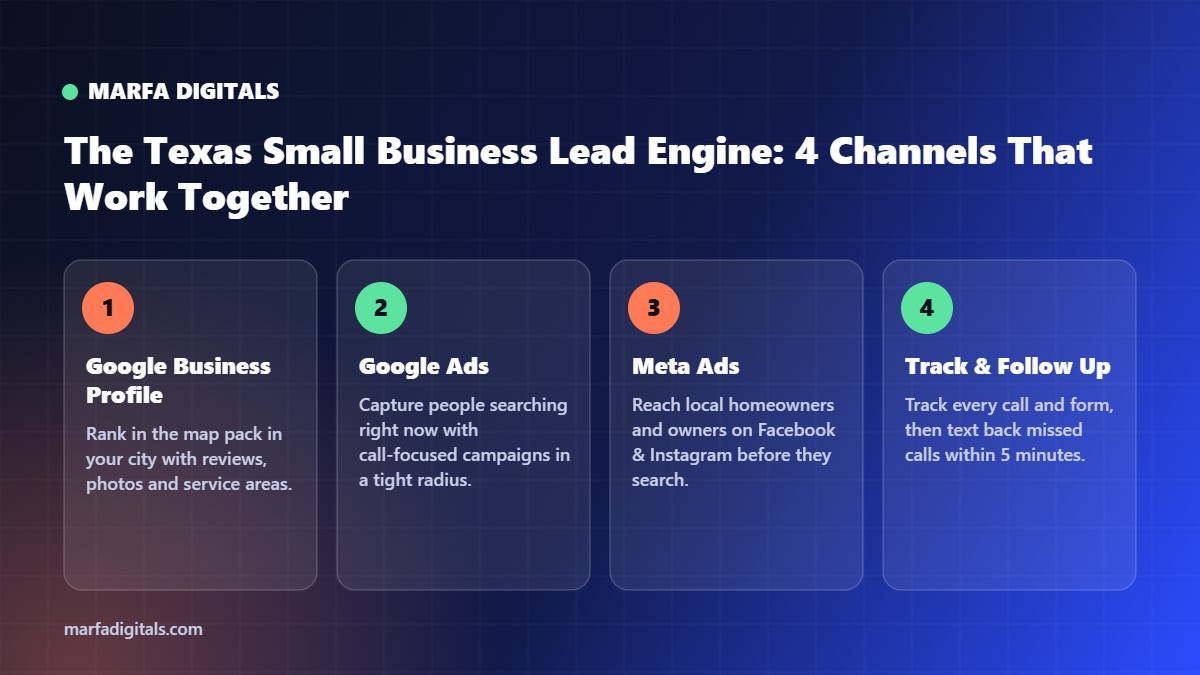
The 4-Step Texas Lead Engine
1. Local SEO and Google Business Profile (the foundation)
Your Google Business Profile is often the first thing a customer sees. Choose the right primary category, list every service, set service areas by city, add real photos and ask every happy customer for a review. Then build one strong page per service on your website that mentions the cities you serve. Our local SEO checklist and guide on how to get more Google reviews walk through it step by step.
2. Google Ads (capture demand now)
Google Ads puts you at the top of search results today, while SEO builds over months. For local businesses, the winning setup is simple: a 10–15 mile radius, high-intent keywords, call assets and a landing page that mentions your city. See our guide to Google Ads radius targeting, and if you’re in a qualifying trade, also consider Local Services Ads.
3. Meta Ads (create demand before they search)
Facebook and Instagram ads reach homeowners, parents and business owners in your area before they ever type a search. They work especially well for offers, seasonal services, med spas, fitness, restaurants, home improvement and anything visual. The key is a local hook (“Serving Frisco families since 2018”), real photos and a lead form with qualifying questions.
4. Tracking and fast follow-up (where most businesses lose money)
If you can’t see which ads produce booked jobs, you can’t scale them. Track calls and forms as conversions, and reply to every lead within minutes. A lead follow-up automation that texts back missed calls can recover leads you are already paying for.
How Much Should a Texas Small Business Spend?
There is no single right number, but here is a practical starting point we see work for local service businesses:
- Local SEO: a monthly retainer or a one-time setup plus ongoing review generation and content.
- Google Ads: enough daily budget to get at least 10–20 clicks a day in your area. In many Texas suburbs that is roughly $30–$100 per day, depending on the trade.
- Meta Ads: $15–$50 per day is enough to test two or three creatives and one offer.
For context, WordStream’s 2025 benchmarks put the cross-industry average Google Ads cost per lead at about $70 (summary via PPC Land). Local campaigns with tight targeting often beat that. Not sure where to start? Read local SEO vs Google Ads.
Texas City Guides
Every city has different competition, customers and costs. Pick your area:
Austin Metro
Dallas–Fort Worth
Greater Houston
- Google Ads management in Sugar Land, TX
- Facebook & Instagram ads in Katy, TX
- Local SEO in Pearland, TX
San Antonio, Central & South Texas
- Google Ads in New Braunfels, TX
- Local SEO in Waco, TX
- Facebook ads in Corpus Christi, TX
- Google Ads in McAllen, TX (English & Spanish)
East & West Texas
What to Do This Week
- Claim and fully complete your Google Business Profile.
- Text five recent happy customers a direct review link.
- Make sure your website has a page for your main service with your city in the title.
- Set up call and form tracking before you spend another dollar on ads.
- Launch one small, tightly targeted Google Ads campaign around your best service.
Want more calls from customers in your Texas city?
We build and manage Google Ads, Meta Ads and local SEO for small businesses — focused on booked jobs, not vanity clicks.
Get a Free Texas Marketing Plan →Frequently Asked Questions
What is the best marketing for a small business in Texas?
For most local service businesses, the best mix is local SEO with a strong Google Business Profile, Google Ads for people searching now, and Meta Ads to reach nearby customers before they search. Start with your Google Business Profile and call tracking.
How much does Google Ads cost for a small business in Texas?
Many Texas small businesses start with about $30–$100 per day in ad spend, depending on the trade and city, plus management fees. Competitive trades in big metros cost more; suburbs and smaller cities are usually cheaper.
Is local SEO or Google Ads better for a new Texas business?
Google Ads brings leads within days, while local SEO builds free traffic over 3–6 months. New businesses usually run both: ads for immediate calls and SEO for long-term, lower-cost leads.
Do Facebook ads work for local businesses in Texas?
Yes, especially for visual services, offers and seasonal demand. Target a 10–15 mile radius, use real local photos and a lead form with qualifying questions to keep lead quality high.
Related articles
 Google Ads Google Ads for Roofers: How Roofing Companies Get More Inspections and Signed Jobs
Read article
 Local Lead Generation Landing Pages for Local Service Businesses: 12 Elements That Turn Clicks Into Calls
Read article
 Local Lead Generation Angi and Thumbtack vs Google Ads: Which Is Better for Local Service Businesses?
Read article